News
Bridging the Financing Gap for Low Carbon Buildings: India’s Green Finance Network
India’s rapid urbanisation presents a major opportunity to shape a more sustainable built environment. With more than half of the infrastructure the country will need by 2050 yet to be built, decisions made today will have long-term implications for future energy demand and emissions. Flagship programmes such as Pradhan Mantri Awas Yojana (PMAY), led by the Ministry of Housing and Urban Affairs, Government of India, also create opportunities to integrate low-carbon, energy-efficient, and climate-resilient building practices at scale.
Despite India’s strong policy framework, including the India Cooling Action Plan (ICAP) and the Energy Conservation and Sustainable Building Code (ECSBC), which establishes minimum energy performance standards for buildings, access to finance continues to constrain the pace at which low–carbon building (LCB) projects move from concept to implementation.
India’s financing challenge is not simply a shortage capital, but an enabling ecosystem that has yet to fully connect viable LCB projects with sustainable finance. Higher upfront costs, limited incentives for lenders and borrowers, and fragmented market information continue to constrain investments. Small developers often lack access to suitable financing, while financial institutions can struggle to identify credible, investment–ready projects that meet both commercial and sustainability criteria.
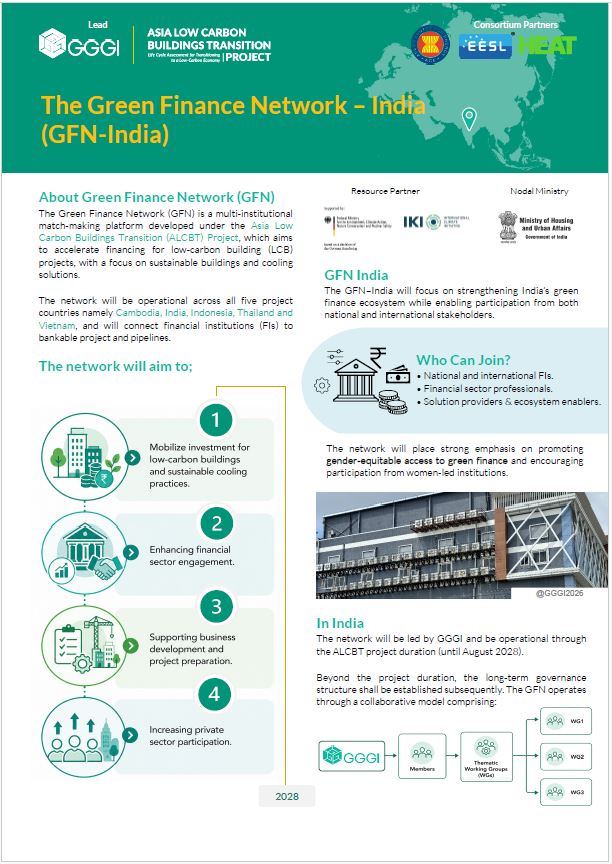
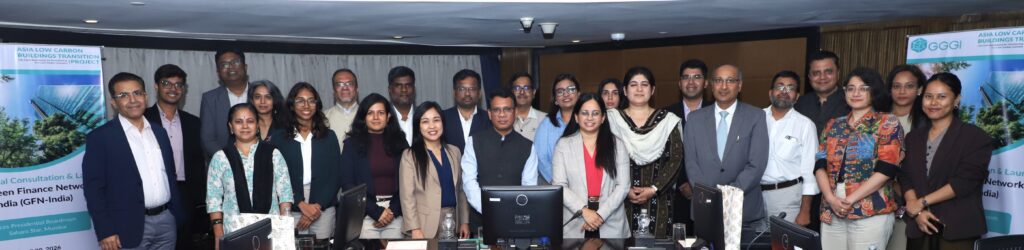
One response to this challenge is the Green Finance Network (GFN), a collaborative, member-led network established under the Asia Low Carbon Buildings Transition (ALCBT) project to accelerate financing for LCBs in India. Rather than serving as a financing facility, the GFN brings together financial institutions, project developers, technology providers, policymakers, and technical experts to identify financing barriers, strengthen project preparation and business development, facilitate knowledge exchange, and encourage greater private sector participation.
By creating a space for these actors to engage, the GFN aims to strengthen connections between credible projects and potential sources of finance. Open to both national and international stakeholders, the network also promotes more inclusive access to green finance by encouraging the participation of women–led institutions and advancing gender responsive approaches across the green finance ecosystem.
For financial institutions, the GFN provides greater visibility into a pipeline of potential investment opportunities and a platform to engage with emerging market trends in sustainable buildings. For project developers and other market actors, it creates opportunities to engage with potential investors and access technical support that can strengthen project bankability, helping reduce information gaps between projects and source of finance.
In India, the project has already begun building the technical foundation needed to support a stronger pipeline of LCB projects. A comprehensive building registry covering 1,687 new and existing buildings has been established across three states, with 302 buildings assessed using the Building Emission Assessment Tool (BEAT). More than 2,800 government officials, industry professionals, ESCOs, and representatives from financial institutions have also been trained to strengthen technical and institutional capacity across the sector.
By 2028, the project aims to mobilise EUR 60 million in investment through policy reforms, institutional strengthening, and market development initiatives. It also aims to identify at least 20 investible building projects that can be brought forward through the GFN for engagement with potential financiers.
India’s low–carbon building transition will ultimately depend not only on whether the right technologies and policies are available, but on whether viable projects can access the finance needed to move forward. The GFN represents an important step towards creating a more coordinated, transparent, and investment–ready market for sustainable buildings.
About ALCBT
The Asia Low Carbon Buildings Transition (ALCBT) Project is a five-year initiative (2023-2028) that seeks to reduce GHG emissions by catalyzing nationwide transitions towards low-carbon buildings in five Asian countries: Cambodia, India, Indonesia, Thailand, and Vietnam. The project is funded by the Government of Germany’s Federal Ministry for the Environment, Climate Action, Nature Conservation and Nuclear Safety (BMUKN), through the International Climate Initiative (IKI), and is implemented by a consortium led by GGGI, in partnership with the ASEAN Center for Energy (ACE), Energy Efficiency Services Limited (EESL), and HEAT GmbH.
In India, the project operates under the guidance of the Ministry of Housing and Urban Affairs (MoHUA). Capacity building efforts in the country will benefit over 2,000 individuals, including government officials, architects, engineers, building developers and owners, ESCOs, financial institutions, material manufactures, and technology providers, to promote low carbon building design and sustainable practices. Learn more about project activities in India here.
For more information, visit: https://alcbt.gggi.org
Date
Countries
- India
Thematic Areas
- News
Categories
- India Featured Posts, India News, Z - Latest News