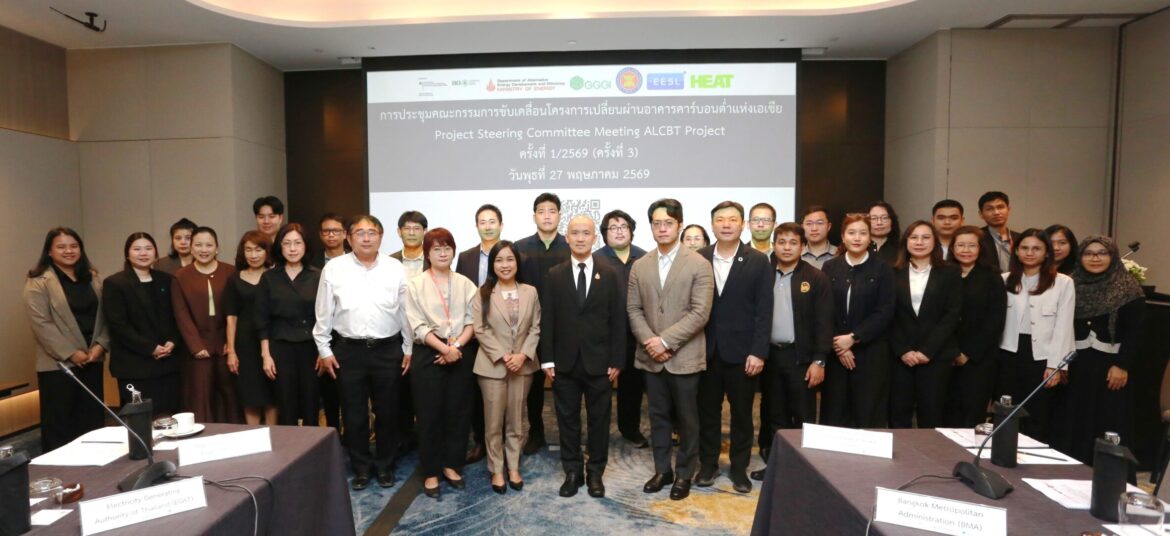
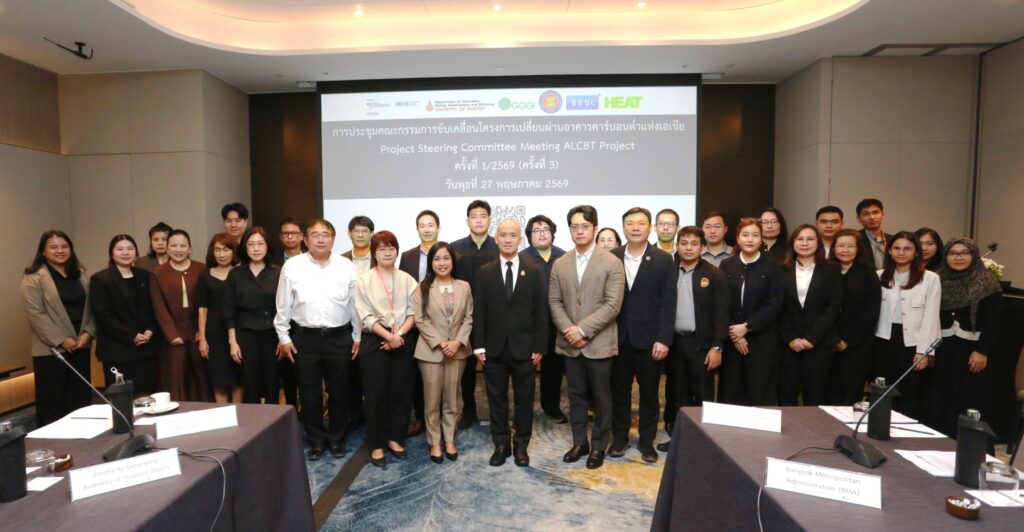
Bangkok, Thailand, 29 May 2026— The Project Steering Committee (PSC) of the Asia Low Carbon Buildings Transition (ALCBT) project in Thailand convened its third annual meeting, reviewing progress across training, tools, and investment mobilization initiatives and endorsing the project’s 2026 work plan.
Key achievements recognized by the PSC include the development, launch, and enhancement of the Building Emission Assessment Tool (BEAT); the development of Green Public Procurement (GPP) Guidelines for Energy-Efficient Air Conditioners in Thailand; and the development of a Measurement, Reporting and Verification (MRV) tool for monitoring and assessing carbon emission reductions in the building sector.
The committee also acknowledged advances in green finance, including a draft framework for the Green Finance Network and the implementation of low-carbon building pilot projects aimed at establishing financial pathways to facilitate financing for occupants, owners, and developers.
Key achievements include strengthening the low-carbon building design proficiency of 281 professionals who participated in a series of Low-Carbon Building Transition Development Pathway courses organized by the project across Thailand since December 2025. ALCBT aims to have 770 professionals trained through the course by August 2027.
The PSC further noted regional progress across ALCBT’s project countries: Cambodia, India, Indonesia, and Viet Nam, and endorsed a 2026 work plan that includes enhancing BEAT, alongside a capacity-building program for 20 government officials on building carbon emission assessment and the application of BEAT in Thailand.
The PSC also advised the project to broaden stakeholder consultation on the GPP Guidelines and on the development of reference datasets.
Speaking during the opening of the meeting, Jisu Min, GGGI Thailand Country Representative and ASEAN Program Development Lead, said: “We have made meaningful strides—the launch of the Building Emission Assessment Tool for building emission assessment, the rollout of our low-carbon building training program reaching nearly 300 people in Thailand, the opening of expressions of interest for technical assistance through the ASEAN-BUILT platform, and the development of green public procurement guidelines for energy-efficient air-conditioners in Thailand.”
“These [ALCBT] initiatives play a key role in supporting Thailand’s Long-Term Low Greenhouse Gas Emission Development Strategy and its Nationally Determined Contribution, both of which aim to reduce greenhouse gas emissions and enhance the country’s energy sustainability,” said Pongpan Vorasayan, Director of the Energy Regulation and Conservation Division at the Department of Alternative Energy Development and Efficiency.
About ALCBT
The Asia Low Carbon Buildings Transition (ALCBT) project is a five-year initiative (2023-2028) that seeks to reduce GHG emissions by catalyzing nationwide transitions towards low-carbon buildings in five Asian countries: Cambodia, India, Indonesia, Thailand, and Vietnam. The project is implemented by a consortium led by GGGI, in partnership with the ASEAN Center for Energy (ACE), Energy Efficiency Services Limited (EESL), and HEAT GmbH. In Thailand, ALCBT works with public and private stakeholders to create a more sustainable pathway for the building value chain, focusing on reducing its growing carbon footprint by addressing barriers to energy efficiency adoption. It supports national commitment to reducing GHG emissions by up to 40% by 2030 and achieving carbon neutrality by 2050.
This project is supported by the Government of Germany through the Federal Ministry for the Environment, Climate Action, Nature Conservation and Nuclear Safety (BMUKN) via the International Climate Initiative (IKI).
Follow us on X | Facebook | LinkedIn | YouTube
For more information, visit: https://alcbt.gggi.org/ | https://gggi.org/